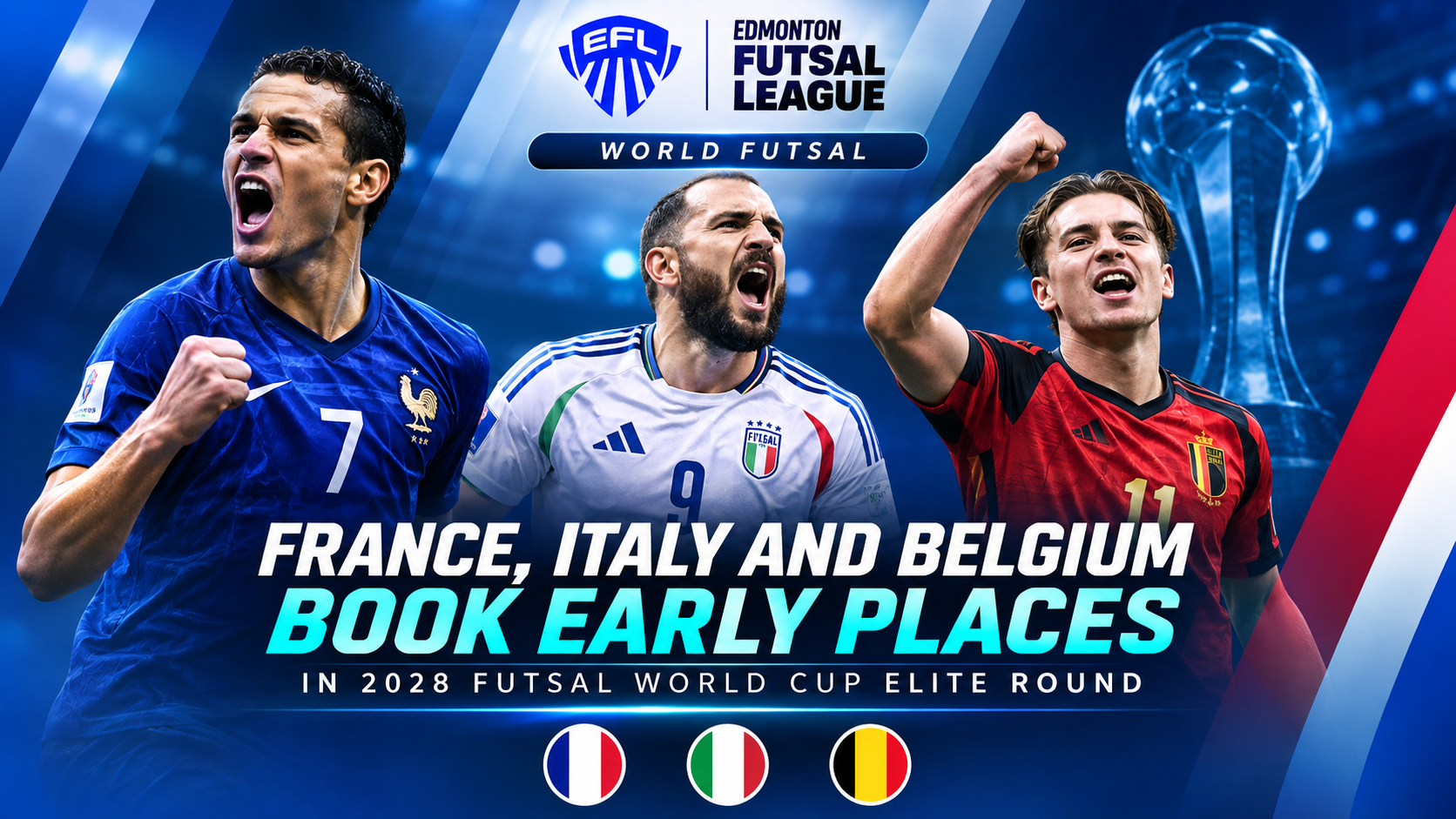
Europe's road to the 2028 FIFA Futsal World Cup is already producing decisive results. France, Italy and Belgium have secured places in the elite round, according to UEFA's November 10 qualifying update, while several traditional contenders still have work to do. The timing is significant. Only days after Spain defeated Brazil to win the Futsal Finalissima, Europe's national teams are turning attention from a showcase trophy to the longer, less forgiving process of qualifying for the next World Cup. The early qualifiers have not booked World Cup places yet. They have simply cleared an important first hurdle. ## France turns momentum into progress France's qualification is especially notable for a country that has been building its international futsal profile. After a 6–0 away victory over Moldova on October 20, Les Bleus beat Montenegro 4–1 at home on November 6 and then 2–0 away on November 10. Three wins, 12 goals scored and only one conceded gave France an unassailable lead in Group 2. That sequence matters beyond the points. France finished fourth on its World Cup debut in 2024, then reached the 2026 European Championship semifinals before losing the bronze-medal match to Croatia. Sustaining that trajectory requires consistency against opponents that may be less celebrated but are still capable of disrupting a qualifying campaign. The French federation had identified the Moldova and Montenegro fixtures as the first stage of its 2028 campaign. Now the team can prepare for the elite round with its immediate qualification objective achieved. The next test will be whether France can turn its rapid emergence into a sustained place among the world's strongest national teams. ## Italy finishes the job in Barletta Italy's breakthrough came in front of a home crowd on November 10. The Azzurri beat Kosovo 3–0 at the PalaDisfida in Barletta, winning Group 10 and securing elite-round qualification with two group fixtures still on the calendar. The Italian federation reported a crowd of nearly 3,000 and confirmed that Salvo Samperi's team had achieved its first qualifying objective. The victory followed a far less comfortable 4–3 win in Kosovo on November 6, when Italy surrendered a three-goal advantage before Giuliano Fortini scored the winner late on. That contrast offers an important lesson in tournament football. Winning a difficult away match is valuable, but following it with a controlled home result can be the difference between qualification and a nervous final stretch. Italy also opened the group with a 3–2 victory over Georgia, giving it three wins from three matches before the November 10 result sealed first place. The reward is more preparation time for a tougher phase, not a place at the finals. Italy must still navigate another group stage if it wants to return to the World Cup. ## Belgium joins the early qualifiers Belgium is the third nation to have secured direct passage to the elite round. Its 6–2 away win over Slovenia on November 10 followed a 4–3 win in Norway and a 2–2 home draw with Slovenia. UEFA lists Belgium as confirmed Group 11 winners. For Belgium, the result is another reminder that the European futsal map is not confined to Spain, Portugal and a small circle of established powers. Nations that invest in national-team continuity, meaningful fixtures and player development can make qualifying groups far more competitive. ## The established powers are still in the race Spain and Portugal remain prominent, but neither was among the first three nations confirmed for the elite round in UEFA's November 10 update. Spain began Group 4 with a 3–1 victory over Finland, while Portugal opened Group 7 with a 10–3 win over Denmark and a 6–1 win in Romania. Those results underline their quality, but qualification is earned through the entire schedule rather than reputation. Croatia, Ukraine and other contenders also recorded important November 10 wins. Croatia beat Lithuania 3–1, while Ukraine defeated Slovakia 2–1. UEFA's format leaves little room for complacency. The 36 main-round teams are divided into 12 groups of three. The 12 group winners and four best runners-up progress directly to the 20-team elite round. The remaining eight runners-up contest play-offs for four more places. The elite round then determines Europe's World Cup representatives. Under the currently announced framework, seven European teams will reach the final tournament, although a European host selection would affect how those places are allocated. ## Why this matters for futsal development For leagues and academies in Canada, this qualifying window provides a useful reminder of what international progress actually looks like. France's rise is not the product of one high-profile result. It is measured through repeat performances, tournament experience and the ability to handle both home and away pressure. Italy and Belgium illustrate different versions of the same principle: national-team credibility is built by converting opportunity into results. There is still a long journey to the 2028 World Cup. But the first European milestones are now clear. France, Italy and Belgium have moved forward, and the rest of the continent has been put on notice.
FRANCE, ITALY AND BELGIUM BOOK EARLY PLACES IN 2028 FUTSAL WORLD CUP ELITE ROUND